Open-Source AI Models in August 2026: GLM-5.3, Ornith-1.5, and the Open-Weight Frontier Closing In
August 2026 may be remembered as the month the open-weight AI frontier caught up with — and in several benchmarks surpassed — its closed-source counterparts. In a single week, six major model releases reshaped the landscape: GLM-5.3 from Z.ai claimed open-source SOTA on coding and cybersecurity benchmarks; Gemini 3.7 Flash brought Google’s coding improvements to a widely accessible price point; Ornith-1.5 from DeepReinforce demonstrated that a fully open-weight, MIT-licensed model can match or beat Claude Opus 4.8 on Terminal-Bench; UI-Mate-27B from Tencent proved that computer use agents can be open-source and practical; Ox Alpha appeared from nowhere to challenge GPT-5.6-sol on DeepSWE; and GEN-1.5 from Generalist AI showed that robots can learn new tasks from a single short demonstration.
For researchers working in computer vision and deep learning — as I do in my pedestrian detection research — these releases are not just benchmark headlines. They represent a fundamental shift in who can access frontier-level AI capabilities, what research is possible without billion-dollar compute budgets, and how the balance of power between open and closed AI is evolving. This article examines each release in depth, analyzes the broader trend toward open-weight parity, and connects these developments to AI research in Morocco and the Maroc IA 2030 strategy.
| Value | Metric |
|---|---|
| 86.1 | Ornith-1.5 397B Terminal-Bench 2.1 |
| 77.0 | UI-Mate-27B OSWorld-Verified |
| 2,436 | Vulnerabilities found by GLM-5.3 |
| 1M | Ox Alpha context window |
| 83% | GEN-1.5 success after 5 min fine-tuning |
| 50% | GLM-5.3 improvement over GLM-5.2 |
1. GLM-5.3: Open-Source SOTA in Coding — and Emergent Cybersecurity
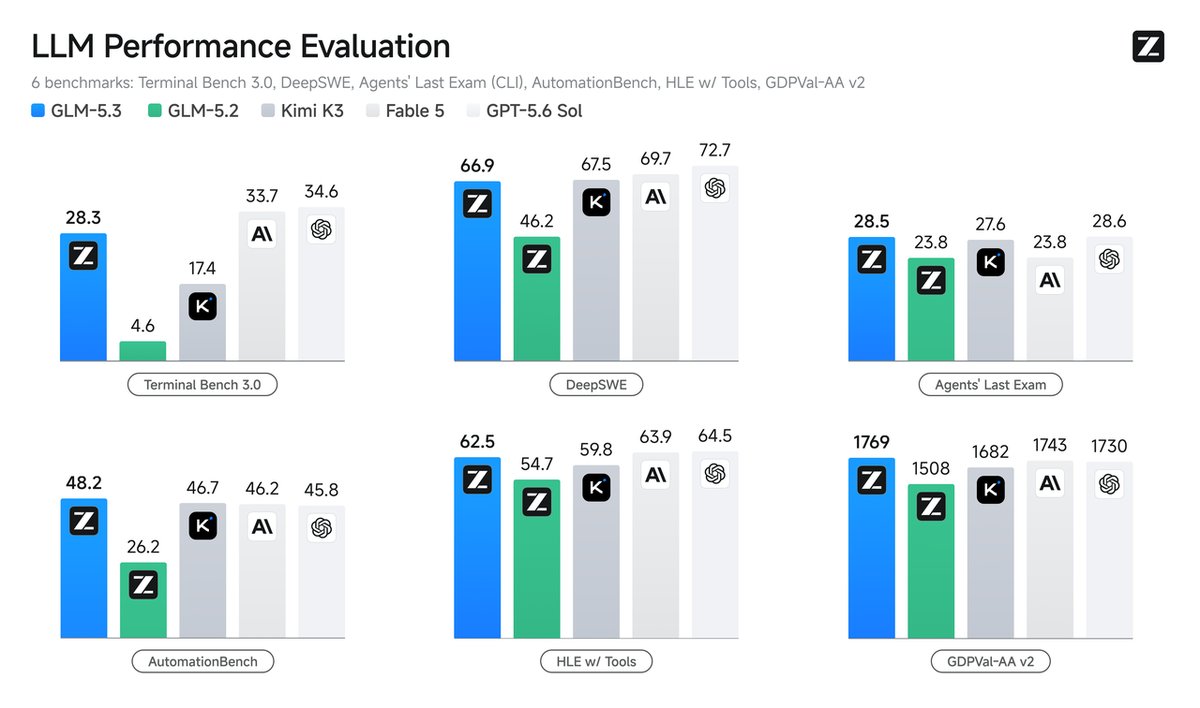
On August 14, 2026, Z.ai (formerly Zhipu AI) released GLM-5.3, an open-weights coding and agent model that immediately made headlines for two reasons: its benchmark dominance and its unexpected cybersecurity capability [1].
Benchmark Performance
GLM-5.3 claims open-source state-of-the-art results on two major coding benchmarks:
- Terminal Bench 3.0: The latest iteration of the widely respected benchmark for evaluating coding agents in realistic terminal environments, where GLM-5.3 achieved top scores among open-weight models.
- Agents’ Last Exam: A challenging benchmark designed to test whether AI agents can complete complex, multi-step tasks autonomously.
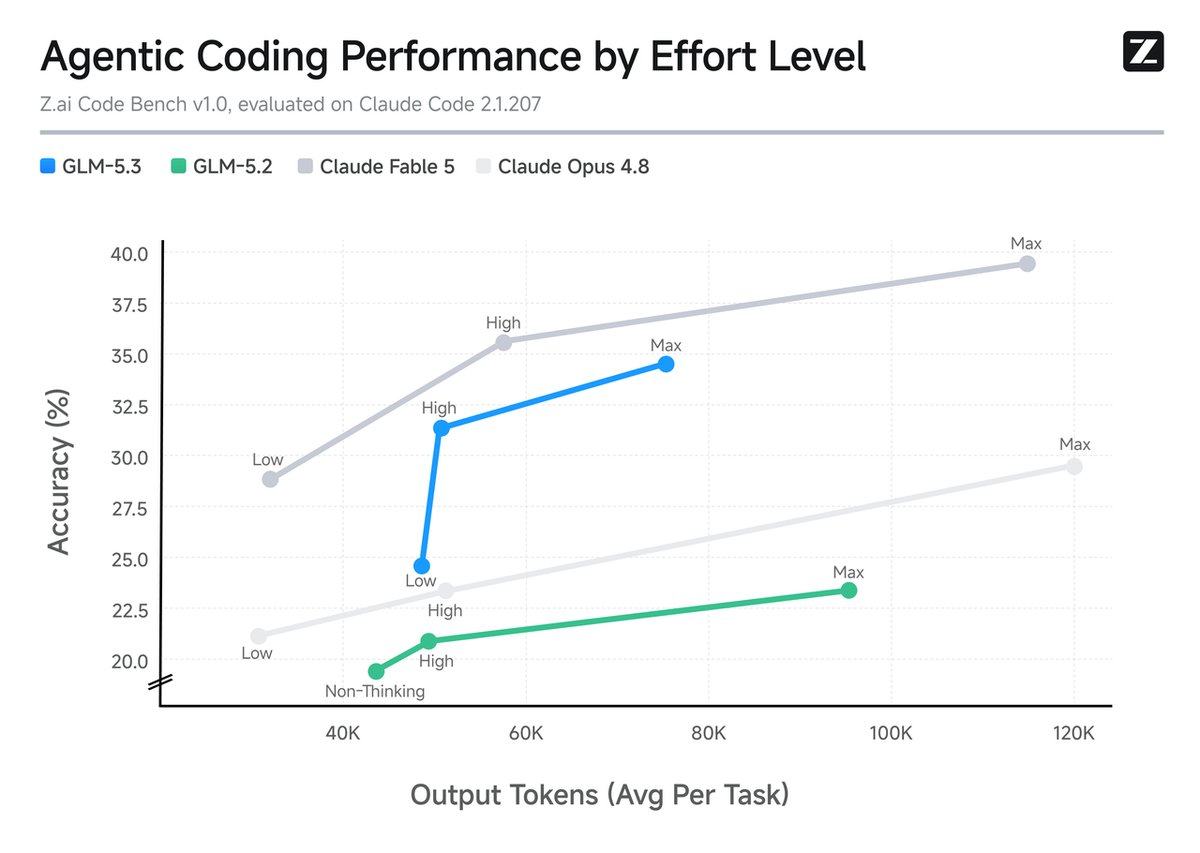
The model also delivers a 50% improvement over GLM-5.2 on Z.ai Code Bench, indicating that the gains are not marginal refinements but substantial leaps in coding capability. Z.ai compared GLM-5.3 against Kimi K3, DeepSeek-V4 Pro, Qwen3.8-Max, Claude Opus 4.8, Claude Fable 5, and GPT-5.6 Sol — a lineup that spans both open and closed frontiers [1].
Post-Training Architecture Choice
A notable technical detail: GLM-5.3 uses the same base model as GLM-5.2, achieving its improvements entirely through post-training optimization. This means the gains come from reinforcement learning, fine-tuning, and data curation applied after pre-training — not from scaling up the base model. The model is built on the slime open-source RL training framework, which Z.ai has made available to the community. This is significant because it demonstrates that meaningful capability gains can come from better training methodology rather than raw compute scaling — a finding with profound implications for research groups and nations that do not have access to the largest training clusters [1].
Emergent Cybersecurity Capability
Perhaps the most striking result is GLM-5.3’s emergent cybersecurity performance. The model achieved state-of-the-art on CyberGym, a benchmark for vulnerability discovery, and discovered 2,436 vulnerabilities across 269 open-source projects, including some that were decades old. This is an emergent capability — the model was not specifically trained for cybersecurity, yet it developed the ability to identify and explain real security flaws in production code. While this is a powerful tool for defensive security, it also raises dual-use concerns that Z.ai has acknowledged by committing to a two-week safety review period before releasing weights [1].
The Open-Weight Safety Debate
GLM-5.3’s cybersecurity capability crystallizes a central tension in open-weight AI: the same capability that makes the model valuable for security researchers — finding 2,436 real vulnerabilities — could theoretically be misused for offensive purposes. Z.ai’s decision to delay weight release for a safety review is one model for responsible open-weight release, but it also means the definition of “open” is being negotiated in real time. Read the announcement →
2. Gemini 3.7 Flash: Google’s Coding Workhorse Gets a Major Upgrade
One day before GLM-5.3, on August 13, 2026, Google released Gemini 3.7 Flash, positioning it as the “workhorse model for coding and agents” in the Gemini lineup [2].
Performance Gains
The improvements over Gemini 3.6 Flash are substantial, particularly on coding benchmarks:
| Benchmark | Gemini 3.7 Flash | Gemini 3.6 Flash | Improvement |
|---|---|---|---|
| FrontierCode 1.1 Main | 43.6% | 34.4% | +9.2 pts |
| DeepSWE v1.1 | 65.3% | 49.0% | +16.3 pts |
Google also reports improvements in web development, UI generation, and document processing, making 3.7 Flash a more capable general-purpose coding assistant [2].
Pricing and Accessibility
Google is offering introductory pricing of $0.75/1M input tokens and $3.75/1M output tokens through the end of 2026. This pricing is aggressive — low enough to make Gemini 3.7 Flash a viable default for production coding workflows while still being a closed, proprietary model. The model powers Gemini Spark, Google’s 24/7 personal AI agent, and ships with updated CBRN and cyber-offense safety safeguards [2].
Why It Matters for the Open-Weight Discussion
Gemini 3.7 Flash is not open-weight, but it sets the performance floor that open-weight models must match or exceed to be competitive. The 65.3% DeepSWE score is the benchmark that Ornith-1.5 and other open challengers are measured against — and, as we will see, some are now meeting or exceeding it.
3. Ornith-1.5: Open-Weight Coding/Agent Model That Matches Claude Opus 4.8
On August 19, 2026, DeepReinforce released Ornith-1.5, an open-weight coding and agent model family that represents perhaps the most significant open-weight release of the month — and arguably of 2026 so far [3].
Model Family and Benchmarks
Ornith-1.5 comes in three sizes:
| Variant | Active Params | Terminal-Bench 2.1 | SWE-bench Verified | GPQA Diamond | BrowseComp |
|---|---|---|---|---|---|
| 397B MoE | — | 86.1 | 86.0 | 92.8 | 86.6 |
| 35B MoE | 3B | 68.5 | — | — | — |
| 9B dense | 9B | Compact model for edge and embedded deployments | |||
The 397B model’s Terminal-Bench 2.1 score of 86.1, surpassing Claude Opus 4.8’s 85.0, is a milestone. For years, the open-weight community has been chasing closed-source models; Ornith-1.5 suggests that gap has effectively closed in coding and agent tasks [3].
Self-Generated RL Training
Perhaps the most innovative aspect of Ornith-1.5 is its self-generated RL training. Rather than relying on human-curated training data for reinforcement learning, the model proposes its own tasks, builds scaffolds, and generates solution rollouts. This approach reduces the dependency on expensive human annotation and creates a virtuous cycle: the model becomes a better teacher of itself as it improves. The implications for research groups without large annotation budgets — including those in developing countries — are significant [3].
Practical Deployment
Ornith-1.5 offers a 262K token context window, extendable to approximately 1M with YaRN scaling. It is available in BF16, FP8, NVFP4, GGUF, and MLX builds, covering the full spectrum from high-precision research to efficient consumer deployment. The 397B model requires approximately 800 GB of memory (8× H200 GPUs) for full-precision inference — a serious infrastructure requirement, but one that is increasingly within reach of well-funded research institutions and cloud providers [3].
Crucially, there is no hosted API. Users must self-host, which means full control over data and inference — a feature, not a bug, for organizations concerned about data sovereignty. The MIT license permits commercial use, modification, and redistribution without restrictions.
The 35B MoE Efficiency Story
The 35B MoE variant, with only 3B active parameters, scoring 68.5 on Terminal-Bench 2.1 is one of the most compelling efficiency results in 2026. It means that organizations without access to H200 clusters can still deploy a competitive coding/agent model on a single GPU. For AI research in Morocco and similar contexts, this efficiency tier is where open-weight models become practically transformative. Read the announcement →
4. UI-Mate-27B: Open-Source Computer Use Agent from Tencent
On August 17, 2026, Tencent released UI-Mate-27B, an open-weight computer use agent under the Apache 2.0 license [4]. This release is significant for the computer vision community because it represents a new application domain for vision models: operating desktop environments from screenshots.
What Is a Computer Use Agent?
A computer use agent takes a screenshot of a desktop environment, interprets the visual content, and generates the appropriate actions (clicks, keystrokes, scrolling) to accomplish a user-specified goal. Unlike traditional computer vision tasks such as object detection or image classification, computer use requires the model to understand not just what is on screen, but how to interact with it — reading menus, navigating dialogs, filling forms, and executing multi-step workflows.
Performance and Capabilities
- OSWorld-Verified: 77.0, surpassing Kimi-2.6’s 73.1 — a meaningful lead on the standard benchmark for computer use agents.
- Cross-platform: Operates across Ubuntu, Windows, and macOS, making it the most versatile open-source computer use agent available.
- In-context demonstrations boost strict success from 17.2% to 35.4%, demonstrating the model’s ability to learn from examples provided at inference time.
Architecture and Deployment
UI-Mate-27B is built on the Qwen3.6-27B base model, with a smaller UI-Mate-9B variant available based on Qwen3.5-9B. It ships with EVIE-Preview-4.5B, a document retrieval model achieving 64.40 nDCG@10 on ViDoRe V3. A free macOS client is available for Apple Silicon. At approximately 55 GB for BF16 weights, the 27B model fits on a single 80 GB GPU, making it deployable by individual researchers and small teams [4].
Connection to Computer Vision Research
UI-Mate-27B demonstrates a critical trend: vision models are expanding beyond traditional computer vision tasks. The same visual understanding that powers pedestrian detection, object recognition, and scene segmentation can be repurposed to interpret graphical user interfaces and take autonomous actions. For my own research in pedestrian detection, this expansion is relevant because the underlying visual encoders — which process screenshots in UI-Mate’s case and camera frames in mine — are converging. Advances in one domain increasingly transfer to the other.
5. Ox Alpha: The Mysterious Model That Nobody Can Identify
On August 20, 2026, a model called Ox Alpha appeared on OpenRouter with no named developer, no organization, and no official documentation beyond a model card [5] [6].
What We Know
- 1M token context window, offered for free on OpenRouter.
- Competitive on DeepSWE: approximately level with GPT-5.6-sol on this demanding benchmark.
- Billions of tokens processed through coding tools including Claude Code, meaning a vast amount of developer code and prompts have been sent to this model.
What We Don’t Know — and Why It Matters
- Model fingerprinting suggests a possible link to Z.ai (formerly Zhipu AI), which is on the U.S. Entity List. If confirmed, this would mean that code processed by Ox Alpha may be flowing to an organization subject to U.S. export restrictions.
- Data retention concerns: The model’s terms indicate that prompts and completions are retained by the unnamed provider. For developers using Ox Alpha through coding tools, this means their source code, architectural decisions, and potentially proprietary information may be stored by an unknown party.
The Ox Alpha situation is a cautionary tale about the asymmetric information dynamics in AI model access. Closed-source models like Gemini 3.7 Flash are transparent about their developer, data practices, and pricing. Open-weight models like Ornith-1.5 and UI-Mate-27B are transparent about their weights, training, and licensing. Ox Alpha is neither: it is closed, unattributed, and free — a combination that should raise questions for any developer with concerns about data sovereignty, intellectual property, or national security [5] [6].
The Data Sovereignty Lesson
Ox Alpha underscores why Morocco’s Maroc IA 2030 strategy emphasizes sovereign computing infrastructure. When developers route their code through an unattributed model with unknown data retention policies, they cede control over their intellectual property. The Jazari ROOT data center and on-premise Mistral AI deployment are designed precisely to prevent this kind of information asymmetry. Read TechCrunch coverage →
6. GEN-1.5: Robot Foundation Model That Learns from a Single Demo
On August 24, 2026, Generalist AI released GEN-1.5, a robot foundation model that takes the open-weight trend in a different direction: from digital agents to physical ones [7].
One-Shot and Few-Shot Physical Learning
GEN-1.5’s headline result is striking: it learns new physical tasks from a single 3–12 second demonstration.
- One-shot in-context prompting: 59% success across 10 tasks, without any gradient updates.
- 10 gradient steps on 5 minutes of data: 83% success — a 24 percentage point improvement from just a few minutes of additional training.
These results represent a step change in robot learning. Current approaches typically require hundreds or thousands of demonstrations to achieve reliable performance on a new task. GEN-1.5’s ability to learn from a single demo — even imperfectly — dramatically reduces the data and time cost of deploying robots in new environments [7].
Emergent Capabilities
GEN-1.5 exhibits several emergent capabilities that go beyond its training distribution:
- Compositional generalization: Combining learned skills in novel ways to solve unseen tasks.
- Zero-shot sim-to-real: Transferring policies learned in simulation directly to physical robots without additional fine-tuning.
- Human-to-robot imitation: Learning tasks by watching a human perform them, even when the human’s embodiment and action space differ from the robot’s.
Availability
GEN-1.5 is a research release with no public weights or API. This limits its immediate impact but still advances the field by demonstrating what is possible and establishing benchmarks for future open releases.
| Model | Release | License | Key Benchmark | Size |
|---|---|---|---|---|
| GLM-5.3 | Aug 14 | Open-weight (pending) | SOTA on Terminal Bench 3.0 | Large |
| Gemini 3.7 Flash | Aug 13 | Proprietary | DeepSWE 65.3% | Flash |
| Ornith-1.5 | Aug 19 | MIT | 86.1 TB-2.1 (397B) | 397B/35B/9B |
| UI-Mate-27B | Aug 17 | Apache 2.0 | 77.0 OSWorld | 27B / 9B |
| Ox Alpha | Aug 20 | Unknown | ~GPT-5.6-sol DeepSWE | Unknown |
| GEN-1.5 | Aug 24 | Research only | 83% after 5 min | Not disclosed |
The Open-Weight Trend: From Catching Up to Pulling Ahead
The six releases of August 2026 tell a coherent story about the state of open-weight AI:
The Performance Gap Is Closing — or Has Closed
Ornith-1.5’s 86.1 on Terminal-Bench 2.1 (vs. Claude Opus 4.8’s 85.0) is a single data point, but it is representative of a broader pattern. GLM-5.3 claims open-source SOTA on Terminal Bench 3.0 and Agents’ Last Exam. UI-Mate-27B surpasses Kimi-2.6 on OSWorld-Verified. In domain after domain — coding, agents, computer use — open-weight models are no longer trailing closed frontiers by large margins; they are matching or exceeding them.
Efficiency Is Becoming a Differentiator
Ornith-1.5’s 35B MoE (3B active parameters) achieving 68.5 on Terminal-Bench 2.1 is as significant as the 397B model’s 86.1. The ability to run a competitive coding/agent model on consumer hardware — or, in UI-Mate-27B’s case, on a single 80 GB GPU — is what makes open-weight models transformative for research groups, startups, and nations that cannot afford proprietary API costs at scale. Gemini 3.7 Flash’s $0.75/1M input tokens is cheap for a single user; it becomes expensive quickly when you are running millions of inference calls for a national AI infrastructure.
The Licensing Spectrum Matters
The August releases span the full licensing spectrum:
| License | Model(s) | Implications |
|---|---|---|
| MIT | Ornith-1.5 | Maximum freedom — commercial use, modification, redistribution without restrictions |
| Apache 2.0 | UI-Mate-27B, Mistral AI Morocco | Permissive with patent grants, suitable for sovereign deployment |
| Open weights (delayed) | GLM-5.3 | Weights available after safety review, balancing openness with responsibility |
| Research only (no weights) | GEN-1.5 | Demonstrates capability without releasing the model itself |
| Closed, proprietary | Gemini 3.7 Flash | Accessible via API but not open-weight |
| Unattributed, unknown | Ox Alpha | No transparency about developer, training, or data practices |
This spectrum is important because it shows that “open” is not binary. The choice between a fully open MIT-licensed model and a delayed-release model with safety review involves real tradeoffs — between accessibility and safety, between innovation speed and responsible deployment, between data sovereignty and convenience.
Self-Generated Training Reduces the Annotation Bottleneck
Both GLM-5.3 (via the slime RL framework) and Ornith-1.5 (via self-generated RL training) demonstrate that the dependency on massive human annotation pipelines is decreasing. Models that can propose their own tasks, generate their own training data, and evaluate their own solutions reduce the cost and expertise barrier to building high-performance AI. For AI research communities in developing countries, this is a paradigm shift: it means that competitive models can be developed with less reliance on the massive annotation workforces that have traditionally been concentrated in a few countries.
Connection to Dr. Razzok’s Research and Morocco’s AI Strategy
These developments have direct relevance to my work and to Morocco’s broader AI trajectory:
Democratizing Computer Vision and Deep Learning
Open-source models are democratizing the same computer vision and deep learning techniques that underpin my pedestrian detection research. When a model like Ornith-1.5 can be downloaded, modified, and deployed under an MIT license, researchers at Moroccan universities can experiment with frontier-level coding and agent capabilities without sending their data — and their intellectual property — to foreign cloud providers. This is not a theoretical benefit; it is a practical one that affects daily research operations.
Alignment with Maroc IA 2030’s Sovereignty Principle
The trend toward open-weight models aligns directly with the Maroc IA 2030 strategy’s principle of technological sovereignty. Morocco’s partnership with Mistral AI uses the Apache 2.0 license for its Arabic, Darija, and Amazigh language models — the same license family as UI-Mate-27B. The Jazari ROOT data center’s 50 MW sovereign compute capacity is designed precisely to enable the kind of self-hosted deployment that Ornith-1.5 requires. When open-weight models match closed frontiers, the case for sovereign infrastructure becomes even stronger: you can have frontier performance and data sovereignty simultaneously.
Vision Models Beyond Traditional CV
UI-Mate-27B’s computer use capability demonstrates how vision models are expanding beyond traditional computer vision tasks like object detection and image classification. The same visual encoders that process camera frames for pedestrian detection can be adapted to interpret graphical interfaces and take autonomous actions. This convergence means that advances in one domain — computer use agents — increasingly transfer to others — autonomous vehicles, surveillance, robotics. For Morocco’s Jazari Smart City Institute, which is tasked with developing AI-powered urban systems, this cross-domain applicability is precisely the kind of capability that open-weight models make accessible.
The Ox Alpha Warning
The Ox Alpha episode is a reminder that not all accessible models are created equal. An unattributed model with unknown data retention policies, possibly linked to a U.S. Entity List organization, processing billions of tokens of developer code through free access — this is the exact scenario that Maroc IA 2030’s sovereignty provisions are designed to prevent. When Morocco builds sovereign infrastructure and partners with transparent providers like Mistral AI under clear licensing terms, it is protecting its developers and institutions from exactly this kind of information asymmetry.
Looking Ahead: What the Rest of 2026 Holds
Several trends from August 2026 are likely to accelerate:
- Open-weight models will continue to close the gap on closed frontiers. Ornith-1.5 has shown that the gap is effectively closed in coding and agents. The next frontiers are multimodal reasoning, long-context understanding, and real-time inference efficiency.
- Self-generated training will become standard. As GLM-5.3 and Ornith-1.5 have demonstrated, post-training improvements through self-generated RL are a scalable alternative to human annotation. Expect this approach to spread across model families and task domains.
- Computer use agents will become a major research and deployment category. UI-Mate-27B is the beginning. The combination of vision understanding, action generation, and cross-platform compatibility will make computer use agents one of the most commercially significant applications of AI in 2026–2027.
- The licensing debate will intensify. As open-weight models become more capable, the question of what to release — weights, training data, training code — and when to release it will become more contentious. GLM-5.3’s two-week safety review delay may become a standard practice, but it will also draw criticism from those who argue that any delay is a restriction on openness.
- Robot foundation models will move from research to deployment. GEN-1.5’s one-shot learning capability, even without public weights, establishes a benchmark that other groups will aim to match and surpass — and when open-weight alternatives appear, the robotics field will undergo the same transformation that coding and agent models are experiencing now.
For my own research program in pedestrian detection and computer vision, these developments open concrete possibilities: adapting open-weight vision encoders for weather-robust detection, leveraging self-generated RL for data augmentation, and exploring computer use agents as a new application domain for the same visual understanding that powers my current work. If you are working on related problems — whether in Morocco or elsewhere — I welcome collaboration.
Sources & References
- Z.ai — “GLM-5.3: Open-Source SOTA in Coding and Cybersecurity”
- Google Blog — “Introducing Gemini 3.7 Flash”
- DataNorth — “Ornith Releases Ornith-1.5”
- DataNorth — “Tencent Releases UI-Mate-27B”
- TechCrunch — “Who’s Behind the New Stealth Model Ox Alpha?”
- SiliconANGLE — “Nobody Knows Who Built AI Coding Model Ox Alpha — or Where the Code Goes”
- MarkTechPost — “Generalist AI Releases GEN-1.5”
Interested in Open-Source AI Research?
Dr. Razzok's research in deep learning and computer vision connects directly to the open-weight AI revolution. Explore collaboration opportunities for research, academic supervision, or consulting on sovereign AI deployment.
Get in Touch →