Maroc IA 2030: Morocco's National AI Strategy, Jazari Institutes & the Road to Digital Sovereignty
On January 12, 2026, Morocco formally launched Maroc IA 2030, its national artificial intelligence strategy, at a ceremony in Rabat. The initiative, themed “AI Made in Morocco: l’IA au cœur de la transformation numérique et des services publics,” represents the kingdom’s most ambitious attempt to position itself as a sovereign AI power — not merely a consumer of foreign technology, but a producer of homegrown artificial intelligence solutions. Led by Minister Amal El Fallah Seghrouchni, the strategy has since produced a concrete institutional architecture: the Jazari Institutes, four public-interest organizations formally established in August 2026 that embed AI research, training, and deployment into the fabric of Moroccan public life [1].
For AI professors and researchers in Morocco, this strategy is not abstract policy. It creates new research infrastructure, expands doctoral and postdoctoral funding, and establishes sovereign computing capacity that directly impacts how AI research in Morocco is conducted. This article examines Maroc IA 2030 in depth: its five strategic pillars, the four Jazari Institutes, the international partnerships underpinning it, and what it means for the future of deep learning and computer vision research in the kingdom.
| Value | Metric |
|---|---|
| 5 | Strategic pillars |
| 4 | Jazari institutes |
| 660 | Government services on Idarati portal |
| 50 MW | Jazari ROOT data center |
| 52M+ | Transactions on national platform |
| +14 pts | AI readiness index improvement |
The Vision Behind Maroc IA 2030
Morocco’s decision to craft a national AI strategy was driven by a clear recognition: AI is not a technology that can be safely imported and deployed without sovereign control. The country’s digital ecosystem — spanning e-government services, healthcare, agriculture, and education — generates data that, if processed exclusively on foreign infrastructure and by foreign models, creates strategic dependencies. Maroc IA 2030 was designed to invert this dynamic, ensuring that Morocco develops, owns, and governs the AI systems that serve its citizens.
The strategy was launched under the authority of Minister Amal El Fallah Seghrouchni, who serves as Minister Delegate to the Head of Government in charge of Digital Transition and Administrative Reform. Seghrouchni’s credentials are uniquely suited to this mandate: she holds a Ph.D. in computer science, has authored over 200 research papers, and previously directed Africa’s first UNESCO center for AI before entering government. Her academic background — combining distributed AI, multi-agent systems, and machine learning — has shaped a strategy that treats AI not as a marketing slogan but as a technical and institutional challenge requiring deep expertise [2].
Morocco is not seeking to become a passive consumer of AI technologies developed elsewhere. The goal is “AI Made in Morocco” — sovereign, trustworthy, and rooted in the country’s own linguistic, cultural, and developmental priorities.
The Five Pillars of Maroc IA 2030
The strategy is organized around five interdependent pillars, each addressing a different dimension of national AI readiness [3]:
1. Technological Sovereignty
The first pillar asserts that Morocco must control its own AI infrastructure — from data centers to model training pipelines. This means building sovereign computing capacity (including a 50 MW data center under the Jazari ROOT institute), reducing dependence on foreign cloud providers for sensitive government and citizen data, and developing Moroccan-trained models that understand local languages, legal frameworks, and administrative processes. Sovereignty is not isolationism; it is the capacity to choose partners on equal terms rather than from a position of dependency.
2. Citizen Trust
AI systems that citizens do not trust will not be adopted, regardless of their technical merits. This pillar focuses on transparency, ethical governance, and accountability. Morocco is establishing AI ethics frameworks, algorithmic auditing mechanisms, and public engagement processes to ensure that AI-driven decisions — especially those affecting public services — are explainable and contestable. Trust is also built through inclusion: the strategy explicitly addresses the risk of AI bias against underrepresented linguistic and demographic groups.
3. Massive Skills Development
Maroc IA 2030 aims to train thousands of AI specialists at every level — from technicians who maintain AI infrastructure to doctoral researchers pushing the boundaries of the field. This pillar encompasses new curricula in universities and engineering schools, professional retraining programs, and partnerships between academia and industry. For AI professors in Morocco, this translates directly into expanded teaching programs, new research grants, and increased demand for advanced AI coursework.
4. Endogenous Innovation
Rather than importing AI solutions designed for other contexts, this pillar calls for innovation that emerges from Moroccan challenges and serves Moroccan needs. The Jazari Institutes are the institutional embodiment of this principle: they are designed to produce AI solutions adapted to Morocco’s specific sectors — agriculture, water management, energy, healthcare — rather than retrofitting solutions built for Silicon Valley or Shenzhen.
5. Territorial Equity
AI’s benefits must not be confined to Rabat and Casablanca. This pillar commits the strategy to deploying AI infrastructure and training programs across all twelve of Morocco’s regions. The plan for twelve regional thematic institutes — one per region — is the clearest expression of this commitment, ensuring that AI-driven modernization reaches Fez, Marrakech, Oujda, Laayoune, and beyond [4].
The Jazari Institutes: Institutional Architecture
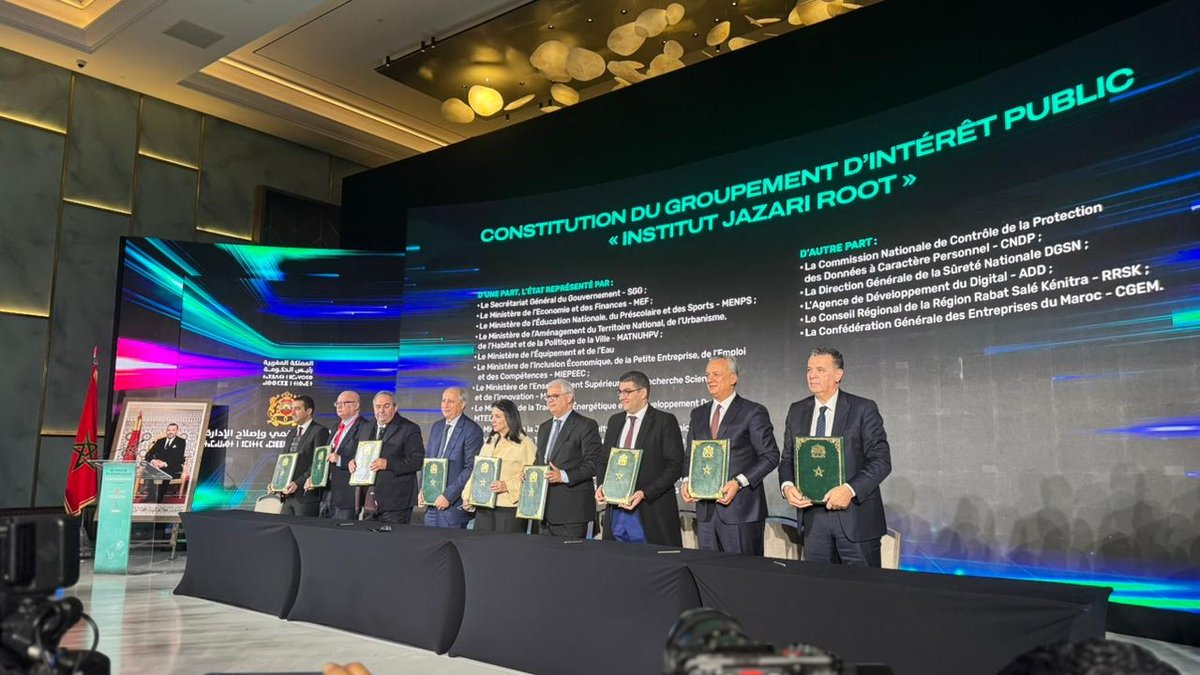
In August 2026, the Moroccan government formally established four Jazari Institutes as public-interest entities (groupements d’intérêt public), giving the Maroc IA 2030 strategy its institutional backbone. The name is deliberate: Abu Al-Izz ibn Ismail Al-Jazari (1136–1206) was a medieval polymath whose Book of Knowledge of Ingenious Mechanical Devices documented over fifty mechanical inventions — including automata and water clocks that are now recognized as early precursors of programmable machines and robotics. By invoking Al-Jazari, Morocco links its AI ambitions to a deep indigenous tradition of engineering and ingenuity [5].
Jazari ROOT (Nucleus)
The flagship institute, Jazari ROOT, serves as the central hub for AI training, research and development, and sovereign digital infrastructure. Its key components include:
- A 50 MW sovereign data center, designed to host Moroccan government data, train national AI models, and provide the computing infrastructure that eliminates the need to rely on foreign cloud providers for sensitive workloads.
- A data factory, tasked with curating, cleaning, and structuring Moroccan datasets — in Arabic, Darija, and Amazigh — to fuel locally-relevant AI models.
- A national software force, a team of engineers dedicated to building open-source and public-sector AI tools that serve government ministries and public services.
- A research and development unit, focusing on fundamental AI research aligned with national priorities.
Jazari ROOT is headquartered on a 20-hectare campus in Rabat, providing the physical infrastructure for concentrated, large-scale AI development. The choice of Rabat — Morocco’s capital and administrative center — signals the institute’s alignment with public-sector digital transformation [6].
Jazari Institute for Education & Technological Innovation
This institute focuses on the AI-driven digital transformation of education. Its mandate spans from redesigning curricula to incorporate AI literacy at every level of schooling, to deploying intelligent tutoring systems that personalize learning for Moroccan students, to training teachers in AI pedagogy. In a country where educational quality varies significantly between urban and rural areas, AI-assisted education tools could become a powerful equalizer — provided they are designed with Moroccan linguistic and cultural contexts in mind.
Jazari Industry X.0 Institute
Morocco’s industrial sector — spanning automotive, aerospace, textiles, and phosphates — is a cornerstone of the national economy. The Industry X.0 Institute is tasked with modernizing Moroccan industry through AI and Industry 4.0 technologies: predictive maintenance, supply chain optimization, quality control through computer vision, and digital twins for factory simulation. The institute works as a bridge between academic AI research and industrial application, translating laboratory innovations into production-floor improvements.
Jazari Smart City Institute
The fourth institute addresses smart urban solutions for Moroccan cities. Morocco is one of the most urbanized countries in Africa, and its cities face mounting pressures: traffic congestion, water stress, energy demand, and waste management. The Smart City Institute develops and deploys AI-powered systems for traffic optimization, energy grid management, water distribution monitoring, and citizen services — all adapted to Moroccan urban contexts rather than imported from smart-city templates designed for Gulf or European cities.
Why “Jazari”?
Abu Al-Izz ibn Ismail Al-Jazari (1136–1206) was a Kurdish-Arab engineer and inventor whose Kitab fi ma’rifat al-hiyal al-handasiyya (Book of Knowledge of Ingenious Mechanical Devices) described over fifty mechanical devices, including automated water clocks, musical automata, and programmable fountains. His work is widely regarded as a precursor to modern robotics and cybernetics. Naming Morocco’s AI institutes after Al-Jazari anchors the country’s AI ambitions in a tradition of indigenous engineering excellence — a powerful counternarrative to the idea that AI innovation belongs only to Western or East Asian technology companies.
Twelve Regional Institutes: Territorial Equity in Practice
Beyond the four national institutes, Maroc IA 2030 plans twelve regional thematic institutes, one for each of Morocco’s twelve administrative regions. Each regional institute will focus on the AI applications most relevant to its territory’s economic and social priorities [4]:
- Energy: AI-optimized renewable energy forecasting and grid management for Morocco’s solar and wind installations
- Water: AI-driven water resource monitoring, leak detection, and irrigation optimization — critical in a water-stressed nation
- Agriculture: Precision agriculture using satellite imagery, drone surveillance, and AI-based crop yield prediction
- Health: AI-assisted diagnostics, telemedicine platforms, and epidemic early-warning systems
- Logistics: Supply chain optimization, port operations AI (Tangier Med is Africa’s largest port), and freight route planning
- Smart Cities: Urban traffic management, waste optimization, public transport AI scheduling
- E-Government: AI-powered administrative process automation and citizen-facing chatbot services
This territorial model ensures that AI expertise and infrastructure are not concentrated solely in Rabat-Casablanca but are distributed across the kingdom — from the northern Rif region to the southern provinces, from the Atlantic coast to the interior plateau.
The Mistral AI Partnership: Sovereign Language Models
One of the most strategically significant elements of Maroc IA 2030 is Morocco’s partnership with Mistral AI, the French AI company. This is not a standard vendor relationship; it is structured as a joint R&D laboratory with a specific mandate: developing Arabic, Darija, and Amazigh language models released under the Apache 2.0 open-source license [2].
This partnership is significant for several reasons:
- Linguistic sovereignty: Morocco’s three principal languages — Modern Standard Arabic, Moroccan Arabic (Darija), and Amazigh (Tamazight) — are severely underrepresented in global AI models. Most large language models are trained primarily on English and a handful of other major languages. Developing dedicated models ensures that Moroccan citizens can interact with AI systems in their own languages, not through the filter of translation.
- Open-source commitment: The Apache 2.0 licensing means that the models, their weights, and their training methodologies will be publicly available. This is a deliberate choice: it enables Moroccan startups, researchers, and public institutions to build upon these foundations without licensing restrictions, fostering an ecosystem rather than creating a walled garden.
- On-premise sovereign deployment: The partnership includes deployment of Mistral AI infrastructure within Morocco’s sovereign data centers, meaning that data processed by these models never leaves Moroccan jurisdiction. This is critical for government data, healthcare records, and other sensitive information.
For AI researchers in Morocco, this partnership opens substantial opportunities: access to cutting-edge model architectures, participation in multilingual model training, and the ability to conduct research on models that understand Morocco’s linguistic landscape.
Digital Public Infrastructure: Services at Scale
Maroc IA 2030 is not only about research and training; it is also about delivering AI-powered public services at scale. The strategy’s track record to date includes [3]:
| Metric | Value | Context |
|---|---|---|
| Government services | 660 | Consolidated on the national digital portal (Idarati) |
| Administrative procedures | 2,450+ | Covering 130+ government administrations, digitized and standardized |
| Platform transactions | 52M+ | Processed through the national interoperability platform |
These numbers matter because they represent the operational foundation on which AI systems will be layered. When 660 government services and 52 million transactions flow through a unified digital platform, the data generated becomes the training material for AI systems that can automate bureaucratic processes, detect fraud, optimize resource allocation, and improve citizen service delivery. The Jazari ROOT data factory is specifically designed to curate this data for responsible AI development.
International Dimensions and Partnerships
Maroc IA 2030 does not pursue sovereignty through isolation. The strategy is explicitly built on strategic international partnerships that bring technical expertise, investment, and institutional knowledge while respecting Morocco’s digital sovereignty requirements [7].
European Union – Morocco Digital Dialogue
In April 2026, Morocco and the European Union signed a series of digital partnership agreements, including the Medusa fiber optic cable project and the establishment of an AI factory in Rabat. These agreements position Morocco as what some observers have called the “third voice in global AI” — neither aligned with the US tech hegemony nor the Chinese model of state-controlled AI, but pursuing a distinctively African and Mediterranean approach that balances openness with sovereignty [7].
Supercomputing Partnerships
Maroc IA 2030 includes four supercomputing centers partnering with Mohammed VI University, providing the raw computing power necessary to train large models, process national-scale datasets, and conduct cutting-edge AI research. These centers are essential for Morocco’s ambition to train sovereign models domestically rather than renting compute from foreign cloud providers.
African Development Bank: AI and GDP
The African Development Bank has projected that AI could add $1 trillion to African GDP by 2035. Morocco’s strategy is explicitly designed to capture a meaningful share of this value — not through passive adoption of foreign AI tools, but through the creation of domestic AI industries, sovereign infrastructure, and a skilled workforce that can both serve Moroccan needs and export AI expertise across Africa [5].
Morocco’s Position in Global AI Readiness
Morocco’s investment in national AI capacity is already producing measurable results. The country has improved 14 points in the AI government readiness index, now ranking 87th worldwide and 8th in the MENA region. While this ranking still leaves significant room for improvement, the trajectory is steep: the institutional infrastructure created by Maroc IA 2030 — the Jazari Institutes, the sovereign data center, the regional institutes, the language model partnerships — is designed to accelerate this improvement dramatically over the next four years [3].
Morocco’s position is also distinctive within Africa. While several African nations have published AI strategies or ethical guidelines, few have matched Morocco’s level of institutional concreteness: four dedicated institutes, a sovereign data center under construction, a multilingual open-source language model partnership, and a territorial network of twelve regional institutes. This architectural approach — building institutions rather than just publishing white papers — is what distinguishes Maroc IA 2030 from aspirational declarations.
What Maroc IA 2030 Means for AI Professors and Researchers
For the AI professors and researchers working in Moroccan universities and engineering schools, Maroc IA 2030 represents a structural transformation of the research landscape. The implications are concrete:
- New research infrastructure: The 50 MW sovereign data center and four supercomputing centers provide compute capacity that was previously unavailable to Moroccan researchers, enabling deep learning and computer vision research at scales that were only feasible through foreign collaborations.
- Funding and doctoral positions: The “massive skills development” pillar creates new funding streams for Ph.D. students, postdoctoral researchers, and principal investigators, expanding the research pipeline.
- Industry-academia bridges: The Industry X.0 Institute and Smart City Institute create structured pathways for academic research to be applied in industrial and urban contexts, reducing the gap between publication and deployment.
- Multilingual model research: The Mistral AI partnership opens research frontiers in Arabic, Darija, and Amazigh NLP — areas that were previously niche but are now national priorities.
- Data availability: The data factory’s curation of Moroccan datasets creates research opportunities in domains from healthcare to agriculture that previously suffered from data scarcity.
As an AI Professor in Morocco, I see Maroc IA 2030 as a watershed moment. The strategy does not merely announce good intentions; it builds the physical and institutional infrastructure — data centers, institutes, partnerships, curricula — that makes sovereign AI development possible. The question now shifts from “whether” Morocco can develop its own AI ecosystem to “how quickly” and “how well” the architecture delivers on its promises.
Challenges and Open Questions
No national strategy of this scale is without risk. Several challenges deserve honest assessment:
- Talent retention: Training AI specialists is only half the battle; retaining them against the pull of higher salaries in Europe, North America, and the Gulf requires competitive compensation, research autonomy, and career pathways within Morocco.
- Execution speed: Building a 50 MW data center, staffing four institutes, and launching twelve regional centers is an enormous operational undertaking. The gap between announcement and operational capacity will test institutional agility.
- Data governance: The data factory’s success depends on clear legal frameworks for data sharing between ministries, privacy protections compliant with Moroccan law, and technical standards for interoperability.
- Open-source sustainability: Releasing models under Apache 2.0 is laudable, but maintaining, updating, and securing open-source AI infrastructure over years requires sustained engineering investment.
- Regional equity in practice: Ensuring that the twelve regional institutes receive equivalent resources, staffing, and research mandates — rather than becoming symbolic outposts of a Rabat-centered ecosystem — will require deliberate governance design.
These challenges are not reasons for skepticism; they are the design constraints that will determine whether Maroc IA 2030 achieves its full potential or settles for partial implementation.
Sources & References
- LesEco — “Maroc IA 2030: la feuille de route dévoilée”
- Rest of World — “Morocco’s AI Minister”
- Morocco World News — “Morocco Launches Maroc IA 2030 Roadmap to Strengthen AI Governance & Digital Sovereignty”
- Aujourdhui.ma — “Lancement de Jazari ROOT: le Maroc structure le déploiement de sa feuille de route”
- Morocco World News — “Morocco Establishes Four Institutes to Drive AI Industry and Smart Cities”
- CGEM — “Signature de la convention constitutive du GIP Institut Jazari ROOT”
- African Business — “Morocco and EU Sign Deals to Become Third Voice in Global AI”
Interested in AI Research in Morocco?
Dr. Razzok's research in deep learning and computer vision aligns with Morocco's national AI strategy. Explore collaboration opportunities for research, academic supervision, or consulting.
Get in Touch →