Computer Vision Research Breakthroughs in 2026: SAFPN, Event-Based Hyperacuity, and What They Mean for Pedestrian Detection
August 2026 has been a remarkable month for computer vision research. Within a single week, five significant papers appeared — spanning adaptive feature pyramids, neuromorphic hyperacuity, conformal safety guarantees for vision-language models, efficient visual relationship detection, and a comprehensive review of explainability methods. Together, they signal a field that is simultaneously deepening its foundations and expanding into entirely new paradigms.
For researchers working on pedestrian detection — as I have throughout my doctoral work and ongoing research program — these advances are not abstract milestones. They are concrete technical innovations that can reshape how we detect people in traffic scenes, under adverse weather, and at the limits of sensor resolution. In this article, I review each paper in depth, explain its core contribution, and discuss the direct implications for pedestrian detection systems built on YOLOv5, Deep-SORT, and conditional GAN pipelines.
| Value | Metric |
|---|---|
| O(B²) → O(KsKo) | VRD search reduction |
| 1.36× | Overall speedup from semantic filtering |
| ~20% | Recall improvement over baseline VRD |
| 57 | CAM-style methods systematically reviewed |
| Sub-pixel | Resolution achieved by event-based vision |
1. SAFPN: Spatial Adaptive Feature Pyramid Network for Small Object Detection
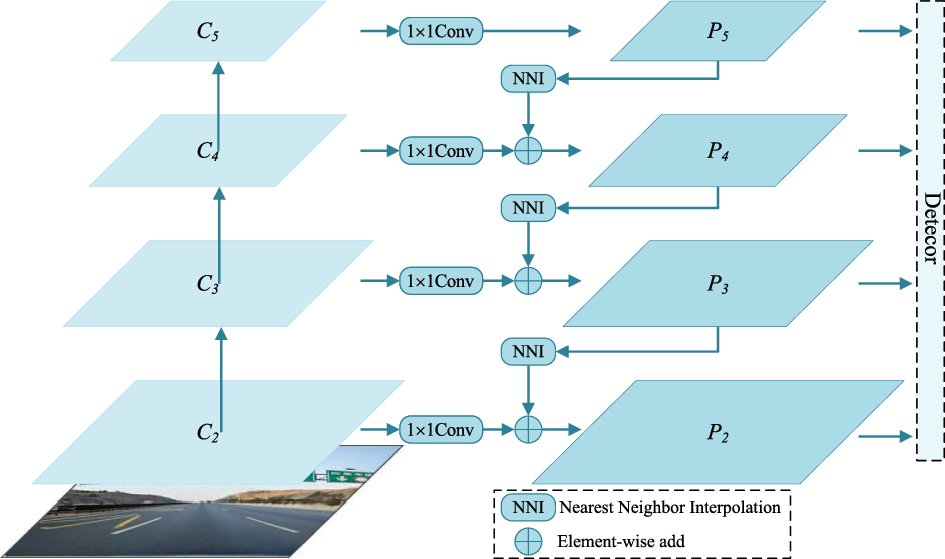
The detection of small objects remains one of the stubborn challenges in computer vision. Whether it is a distant pedestrian in a traffic scene, a traffic sign at the horizon, or a small vehicle in aerial imagery, small objects consistently suffer from low feature resolution and information loss during the down-sampling and up-sampling stages of conventional feature pyramid networks (FPNs).
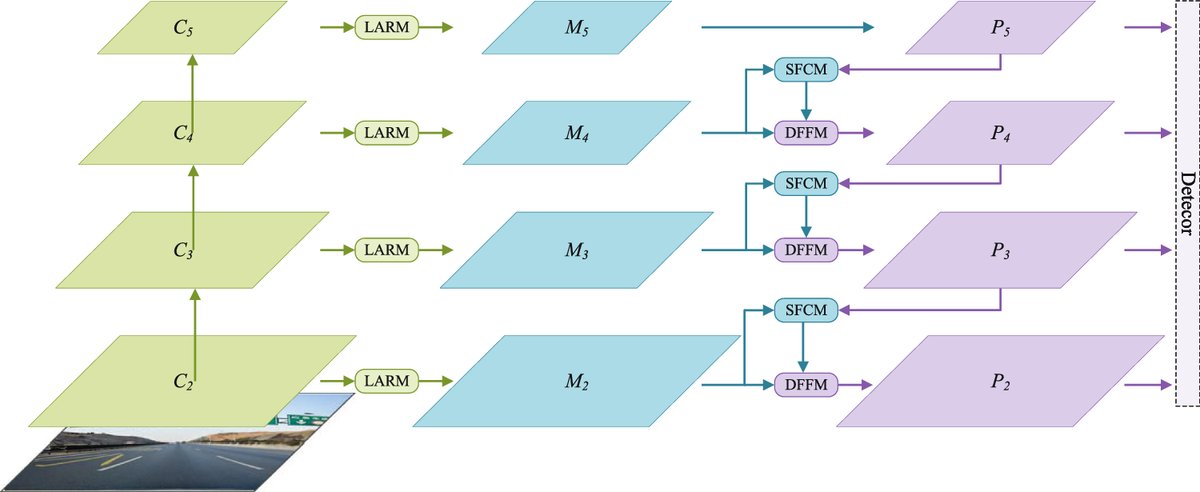
SAFPN (Spatial Adaptive Feature Pyramid Network), published on August 19, 2026 in Scientific Reports (Nature), directly tackles this problem. Authored by Zijian She, Kailin Xie, Zhixuan Xiao, Kunhua Wen, and Liang Lei from the Guangdong University of Technology, the paper introduces three complementary modules that retrofit the standard FPN architecture:
LARM: Lateral Adaptive Representation Module
Traditional FPNs merge multi-scale features through simple addition or concatenation of lateral connections. LARM replaces this with an adaptive representation mechanism that learns to weight lateral features according to their spatial and channel-wise relevance. Rather than treating all lateral features equally, LARM assigns learned importance coefficients, allowing the network to preserve fine-grained details from higher-resolution feature maps — precisely the details that small objects depend on.
SFCM: Spatial Feature Correction Module
Even with adaptive lateral connections, spatial misalignment between feature maps at different scales can introduce feature confusion — where the fused representation mixes signals from different spatial locations. SFCM applies spatial correction kernels that realign features before fusion, reducing aliasing artifacts and ensuring that small-object features are spatially consistent across scales.
DFFM: Dynamic Feature Fusion Module
The final module, DFFM, addresses a limitation of static fusion weights. In dynamic scenes, the relative importance of different feature scales changes from image to image — a small, distant pedestrian relies more on early high-resolution features, while a large, close pedestrian benefits from deeper semantic features. DFFM introduces input-dependent fusion weights that adaptively combine features based on the content of each specific image.
Key Results from SAFPN
The authors demonstrate significant improvements on three major benchmarks: MS COCO, PASCAL VOC, and TT-100K (the traffic sign detection dataset). Critically, SAFPN can be integrated as a plug-in module into various FPN architectures and object detectors, meaning existing pipelines — including YOLO-based pedestrian detectors — can adopt it without a full redesign. Read the paper (Nature) →
Connection to Pedestrian Detection
In my pedestrian detection research, small and distant pedestrians are a persistent failure mode for YOLOv5-based detectors. SAFPN's three-module approach directly addresses this: LARM preserves the high-frequency features that encode a distant pedestrian's silhouette, SFCM prevents those features from being spatially misaligned during fusion, and DFFM ensures the fusion adapts to whether the scene contains primarily small or large objects. Integrating SAFPN-style modules into the YOLOv5+Deep-SORT pipeline could measurably improve detection recall at distance — a known weak point in current systems.
2. Temporal Coding Enables Hyperacuity in Event-Based Vision
On August 20, 2026, Nature Communications published a paper that challenges a fundamental assumption in computer vision: that the pixel grid defines the resolution limit of an artificial vision system. The paper, "Temporal Coding Enables Hyperacuity in Event-Based Vision," is authored by Eldad Assa and Alexander Rivkind (Weizmann Institute of Science), Michael Kreiserman, Fahad Shahbaz Khan, and Salman Khan (Mohamed bin Zayed University of Artificial Intelligence), with Ehud Ahissar (Weizmann Institute).
The core finding is striking: artificial systems can achieve hyperacuity — sub-pixel resolution — by exploiting the temporal coding in event-based (neuromorphic) vision sensors.
What Is Hyperacuity?
In biological vision, hyperacuity refers to the ability to discriminate spatial details finer than the spacing between photoreceptors on the retina. Vernier acuity — the ability to detect a misalignment between two vertical lines that is far smaller than a single photoreceptor's receptive field — is a classic example. The biological mechanism relies on temporal coding: the precise timing of neural spikes carries information about edge location that exceeds the spatial sampling density.
From Biology to Silicon
Event-based cameras, such as the Dynamic Vision Sensor (DVS) and its successors, mimic this principle. Unlike conventional frame-based cameras that capture the entire scene at fixed intervals, event cameras output a continuous stream of asynchronous "events" — each triggered by a pixel-level brightness change, tagged with a microsecond-precision timestamp. The authors demonstrate that when an ANN model is trained on these spatio-temporal event streams, it can resolve spatial details at sub-pixel resolution, outperforming conventional frame-based models on the same recognition tasks.
This result is significant for two reasons. First, it shows that the temporal dimension of visual data carries recoverable spatial information — information that frame-based cameras discard by integrating over exposure time. Second, it opens pathways for building energy-efficient neuromorphic AI vision systems that achieve higher effective resolution without requiring higher pixel counts or more expensive sensors.
Patent Filed
The authors have filed a patent application: PCT/IL2026/050239, indicating the commercial and practical relevance of this discovery beyond academic benchmarks. Read the paper (Nature Communications) →
Connection to Pedestrian Detection
My research on pedestrian detection under adverse weather using conditional GANs addresses one side of the robustness problem — training detectors on synthetic weather-corrupted images. Event-based vision addresses the other side: the sensor itself. In fog, heavy rain, or snow, a conventional camera's pixel values become unreliable — the entire frame degrades simultaneously. An event camera, by contrast, responds only to changes in brightness. A pedestrian moving through fog still triggers temporal events at the silhouette boundary, even when the overall contrast is severely reduced. Combined with the hyperacuity finding, this suggests that event-based pedestrian detection could achieve both weather robustness and sub-pixel localization — a powerful combination for real-time traffic safety systems.
3. Marginal Coverage vs. Class-Conditional Safety for Zero-Shot VLMs
As vision models grow larger and are deployed in higher-stakes settings, the question of reliability guarantees becomes urgent. On August 19, 2026, Jai Kumar Sharma and Amartya Dutta published a paper on arXiv (accepted at the ECCV 2026 Workshop) that reveals a deeply concerning gap in how we evaluate the safety of zero-shot vision-language models (VLMs).
The paper, "Marginal Coverage vs. Class-Conditional Safety for Zero-Shot VLMs," examines conformal prediction — a popular framework for assigning calibrated confidence sets to model predictions. The key findings are:
- Marginal coverage can remain high (~0.86) while worst-class coverage collapses to approximately zero on shifted data. In other words, the average looks acceptable even as individual classes receive no reliable coverage.
- 10–12% of classes fall below the null floor — meaning they perform worse than random guessing — when evaluated under distribution shift.
- Mondrian calibration does not transfer to shifted data, undermining one of the standard approaches to class-conditional coverage.
- Clustered conformal methods improve averages but do not recover worst-class tail performance. The most vulnerable classes remain unprotected even after applying more sophisticated calibration strategies.
- A 2–3× cross-family efficiency gap exists between different model families, revealing systematic structural differences in how well conformal prediction works across architectures.
For pedestrian detection, these findings are a cautionary tale. A deployment-grade detector that reports an average confidence of 86% might be concealing the fact that entire subcategories of pedestrians — children, partially occluded figures, pedestrians at unusual poses — receive essentially zero calibrated coverage. This is precisely the kind of failure mode that safety-critical systems must prevent. Read the paper (arXiv) →
4. Semantic Filtering & Greedy Matching for Open-Vocabulary Visual Relationship Detection
Visual Relationship Detection (VRD) — the task of identifying not just objects but the relationships between them (e.g., "pedestrian crossing street") — is essential for scene understanding in traffic applications. But transformer-based VRD models face a computational bottleneck: the quadratic pair explosion of potential subject-object combinations and the cubic cost of Hungarian matching for assignment.
Published on August 19, 2026 in Discover Artificial Intelligence (Springer), Nguyet Nguyen, Cong Tran, Trung Tran, and Cuong Pham propose an elegant two-part solution:
Query-Driven Semantic Filtering
Instead of evaluating all O(B²) possible subject-object pairs in a scene with B detected objects, the authors use YOLO for initial detection, RegionCLIP for region-level visual embedding, and sentence embeddings to semantically filter pairs. Only pairs whose combined semantics are plausible under the query are retained, reducing the search space from O(B²) to O(KsKo), where Ks and Ko are the numbers of semantically plausible subject and object candidates.
Lightweight Greedy Assignment
The standard Hungarian algorithm solves the bipartite assignment problem in O(Q³) time, where Q is the number of query-pair matchings. The authors replace this with a greedy assignment strategy that runs in O(Q² log Q) time — a significant reduction that makes real-time VRD feasible.
Performance Gains
The combined approach achieves a 1.36× overall speedup and approximately 2.74× speedup in the relationship reasoning stage. Recall improves by approximately 20% over baseline, and the method retains approximately 66% of seen-class recall on novel categories — demonstrating strong open-vocabulary generalization. Read the paper (Springer) →
Connection to Pedestrian Detection
The YOLOv5+Deep-SORT pipeline I use in my research detects and tracks individual pedestrians but does not model relationships between them — who is walking with whom, who is waiting to cross, who is interacting with a vehicle. Semantic filtering and greedy matching from this paper could extend the pipeline to relationship-aware pedestrian tracking without the quadratic computational cost that previously made this impractical. In a smart-city context, understanding that "a pedestrian is waiting at a crosswalk" versus "a pedestrian is walking across traffic" is a distinction that matters for real-time safety decisions.
5. Class Activation Mapping in Explainable Computer Vision: A Comprehensive Review
The fifth paper, published on August 12, 2026 on arXiv, takes a step back from novel architectures and provides a systematic review of 57 method-centered papers on CAM-style explanations, spanning the period from the original CAM paper (2016) to the present.
The review maps the evolution of explainability in computer vision through several phases:
- Single-class-score CNN explanations (Grad-CAM and its variants), which generate attribution maps by backpropagating class-specific gradients through convolutional layers.
- Multi-modal and multi-task explanations, which extend attribution to settings with multiple inputs or objectives.
- Foundation-model-aware explanations (CLIP, DINO, SAM), which face new challenges: larger, more complex architectures where the relationship between individual attention heads and spatial features is far less interpretable than in earlier CNNs.
A key finding of the review is the fragmented state of evaluation. Different papers measure explanation quality using different protocols for faithfulness, localization accuracy, robustness, computational cost, and human trust — making it difficult to compare methods or determine which explanation approach is genuinely superior. The authors call for standardized benchmarks to enable meaningful comparison. Read the review (arXiv) →
Connection to Pedestrian Detection
Explainability is not an academic luxury in pedestrian detection — it is a safety requirement. When a detector misses a pedestrian, investigators and engineers need to understand why. CAM-based explanations are the most widely used tool for this purpose, and this review clarifies both their capabilities and their limitations. For my own work, the review underscores the importance of choosing explanation methods whose evaluation protocol matches the deployment context: a faithfulness metric tells you whether the explanation reflects what the model actually computed, while a localization metric tells you whether the highlighted region overlaps the pedestrian — and these are not the same thing.
| Paper | Venue | Key Contribution | Relevance to Pedestrian Detection |
|---|---|---|---|
| SAFPN | Sci. Reports | Small object detection via adaptive feature fusion | Direct — better detection of distant pedestrians |
| Event-Based Hyperacuity | Nature Comms | Sub-pixel resolution from temporal coding | Complementary — robust detection in extreme conditions |
| Marginal vs. Class Safety | ECCV WS | Worst-class coverage collapses on shifted data | Moderate — safety guarantees for deployed CV systems |
| Semantic Filtering VRD | Springer | Efficient open-vocabulary relationship detection | Moderate — understanding scene context |
| CAM Explainability Review | arXiv | Systematic review of 57 CAM methods | High — understanding model decisions |
Synthesizing the Advances: Implications for Pedestrian Detection Research
Individually, each of these papers addresses a specific technical challenge. Together, they sketch the outline of a next-generation pedestrian detection system:
- Better small-object detection through adaptive feature pyramids (SAFPN) addresses the fundamental limitation of current YOLO-based detectors at distance, where pedestrians occupy only a handful of pixels and conventional FPNs lose critical detail during multi-scale fusion.
- Weather-robust sensing through event-based cameras (hyperacuity paper) offers a hardware-level complement to the software-level weather robustness that my conditional GAN work provides. The two approaches are not competing — they are complementary. cGANs expand the training distribution to include weather variations; event cameras expand the sensing modality to be inherently more robust to those variations.
- Reliable confidence calibration (conformal safety paper) ensures that deployment-grade detectors do not silently fail on vulnerable subcategories of pedestrians. Average-case metrics are insufficient for safety-critical systems; class-conditional guarantees are necessary.
- Relationship-aware scene understanding (semantic filtering paper) extends the detection-and-tracking pipeline to model interactions between pedestrians, vehicles, and infrastructure — enabling richer, more contextually aware safety decisions.
- Trustworthy explanations (CAM review) ensures that when a system fails, the failure mode can be identified, communicated, and corrected — a non-negotiable requirement for any AI system deployed in public safety.
This convergence is particularly exciting for researchers in Morocco's growing AI ecosystem. The challenges of traffic safety in Moroccan cities — diverse weather, dense urban scenes, varied pedestrian behavior — are exactly the conditions that expose the limitations of current detectors and demand the kind of innovations these papers represent.
Looking Ahead: From Incremental Gains to Paradigm Shifts
What stands out in this batch of August 2026 papers is not just the quality of individual results, but the breadth of the field's evolution. We are seeing three simultaneous shifts:
- From fixed architectures to adaptive ones. SAFPN's dynamic fusion and the event-based vision paper's input-dependent temporal processing both reflect a move away from one-size-fits-all network designs toward systems that adapt their computation to the input.
- From accuracy-only evaluation to safety and reliability guarantees. The conformal prediction paper's finding — that marginal coverage can mask catastrophic per-class failures — is a wake-up call for the entire community. Building accurate models is necessary but not sufficient; building trustworthy models requires class-conditional guarantees.
- From object detection to relational and causal understanding. The VRD paper's semantic filtering approach and the CAM review's call for foundation-model-aware explanations both point toward systems that understand not just what is in a scene, but how entities relate and why the model made its predictions.
For my own research program, these shifts are both a validation and a challenge. The conditional GAN approach to weather-robust pedestrian detection was an early bet on adaptation — generating training data that reflects the conditions a deployed system will face. The event-based vision result suggests that adaptation can go deeper, all the way to the sensor modality. The conformal prediction result reminds us that adaptation must be accompanied by rigorous reliability guarantees — otherwise, we risk deploying systems that appear robust on average but fail silently on the very subpopulations where failure is most dangerous.
I plan to explore SAFPN-style adaptive fusion modules in the YOLOv5+Deep-SORT pipeline, and to investigate event-based sensing as a complementary modality for weather-robust pedestrian detection. If you are working on related problems — whether in Morocco or elsewhere — I welcome collaboration.
Collaborate on Computer Vision Research
Interested in advancing pedestrian detection, feature pyramid architectures, or neuromorphic vision? Dr. Razzok welcomes research partnerships, academic supervision inquiries, and joint publications.
Get in Touch →